
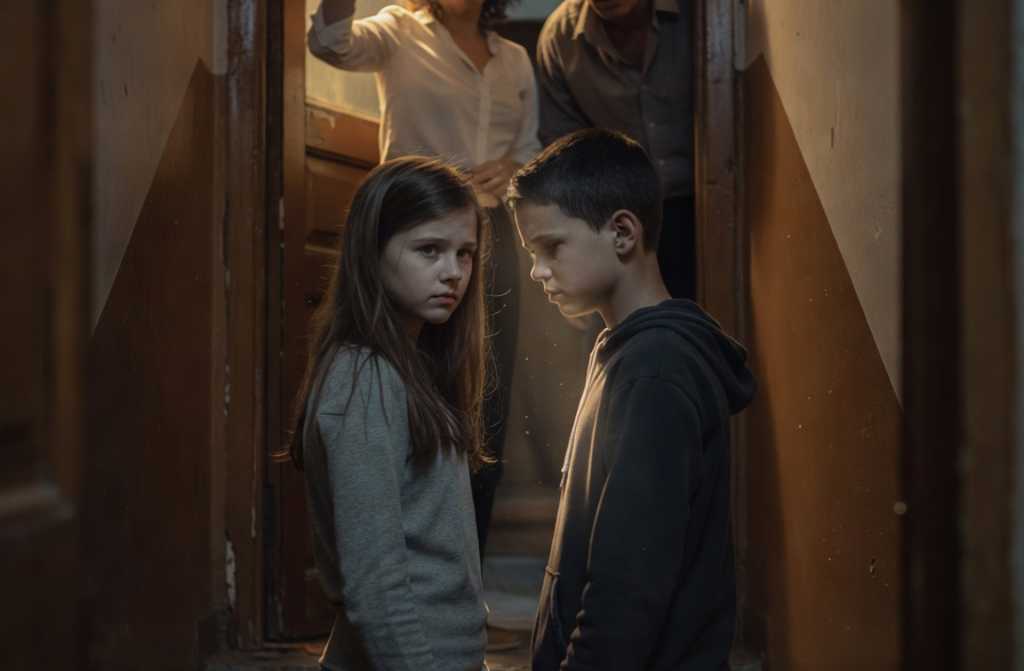
What’s wrong with you again?! How much longer can this go on?! I’ve had enough of it all! a woman’s voice, coming from behind the door of one of the apartments, carries through the entire staircase.
Right now Zuzanna and Mateusz are making their way up the stairs. They stop dead in their tracks, as though they have collided with an unseen barrier. For a brief moment their eyes lock, and in that quick exchange no words are required. Both grasp the situation without a sound: leaving is the wiser choice now. Sighing together, they pivot and slip away from the building without a word. Returning to the apartment is clearly not on their minds today.
Who would choose to spend an evening listening to nonstop parental fights? Not them, for sure! The kids march straight toward the next staircase entrance that’s where their grandma Jadwiga lives. Her place has turned into their real haven lately. Where they once dropped by only on weekends, they now seek shelter there almost nightly.
The mood at their parents’ home has grown unbearable long ago. The parents, lost in their own world, yell at each other without pause. Worst of all, they pull the children into these fights more and more often.
At times the mother spins toward her daughter and presses her:
Tell me I’m right, won’t you? You agree with me, right?
At other times the father cuts in before any reply and turns to his son:
No, I’m the one who’s right here! Back me up!
Zuzanna and Mateusz stay quiet. They refuse to pick sides or join this endless clash. All they want is quiet, peace, and warmth the very things they find at grandma’s.
These outbursts happen every single day, like a scratched record nobody will stop. The children have learned to spot the signs early. A certain tone, sudden sharp moves, the way the parents glance at each other all signal it’s time to slip away. What child enjoys constant strain, where any talk can explode into a loud row in seconds?
The kids still can’t work out what set off this disaster. Their family was never perfect like families in TV ads, yet the parents once knew how to settle things. Fights broke out now and then, of course they’re bound to happen but they ended in calm talks, not shouts. Mom might scowl, dad might raise his voice slightly, yet half an hour later everything was smoothed over. Everyone gathered at the table again, sipped tea, and planned the weekend.
Roughly two years back it all shifted… Someone seemed to swap the old parents for new ones who now quarrel over the smallest things. A dirty cup left on the table? A long lecture on carelessness and disrespect. A shirt on the wrong hook? Sharp comments about keeping the house tidy. A spoon forgotten in the sink? Practically a crime needing endless discussion!
One evening Zuzanna sits in grandma’s kitchen, stirring her tea without thinking. She stays silent for a while, watching the golden swirls in the cup, then asks with a trace of bitterness:
How did it come to this, grandma? Everything changed after their trip together. What went on there?
Jadwiga pauses, sets her cup on the saucer, and softly touches Zuzanna’s hand. She only guesses at the reasons for the family rift, and those guesses bring her no comfort.
Grown-ups will handle it themselves, she answers gently, keeping her voice steady. Sometimes folks need space to decide what’s best.
Zuzanna nods, yet doubt lingers in her eyes. She senses grandma holds something back, but she lets it drop. No use pushing. While they still see her as a child, nothing important will be shared.
We can’t take these shouts anymore! Mateusz bursts out in despair. Can’t finish homework in peace or read a book! I can’t even recall the last time we sat down together as a family. If being together is this hard for them, they should just split it’ll ease things for everyone!
The words tumble out, yet they carry the full weight of recent months. Mateusz speaks for both he knows his sister feels it too. Silence left their home long ago: mom snaps, dad answers sharply, and another row starts with nowhere to hide.
Mateusz… grandma falters. She sets her knitting aside, studies her grandson, and shakes her head slowly. Have you thought about what happens if they split? You’d be divided. Are you ready to live apart from Zuzanna?
We’ll stay with you! Zuzanna jumps in, pleading with her eyes. We already spend nearly every day here! You wouldn’t mind, would you?
Jadwiga holds still. She feels the grandchildren’s pain sees how worn they are from the constant rows. On one side, the children would be safe here, in a steady, kind space where homework gets done without yelling, books read in quiet, and they feel looked after. She loves them deeply and stands ready to wrap them in care.
On the other side, what about the parents? How to explain that the children no longer wish to stay home? Would they accept this? And if they did, how might it shape their bond with the kids? Could this step lead to a total break with the parents?
Let’s not rush, the woman says after a long breath. I’m always glad to have you here, you know that. But first let’s speak with your mom and dad. Maybe together we can find a way to mend things.
Don’t worry, we’ll talk to them ourselves, Zuzanna says with confidence, smiling brightly. Grandma is nearly on board, and that’s what counts! Just don’t turn us down, please! We truly can’t stay there anymore! It would be better for them apart or one day they might actually harm each other! I saw dad lift his hand at mom yesterday… He didn’t strike, truly! But he came close.
Zuzanna stops, recalling that awful instant. She had stepped into the kitchen for water and stood frozen in the doorway: dad faced mom sideways, his arm shot upward, and mom ducked on instinct. A heartbeat later he dropped it, yet that heartbeat stretched forever for Zuzanna.
Grandma, please say yes! Mateusz backs his sister. He moves nearer, grasps grandma’s hand as though fearing refusal. We’ll help around the house with everything. Just don’t send us back there. They pay us no mind at all! Yesterday I told dad about the parent meeting. Know what he said? Go ask your mom! So I did. Guess what she told me?
Go ask your dad? Jadwiga asks softly, already certain of the reply.
Spot on! Mateusz gives a bitter laugh. Then they argued for two more hours over who would attend. Sat in separate rooms and shouted down the hall. I just stood there listening.
I asked them to sign the form for the museum trip, Zuzanna adds, eyes down. Her fingers twist the cuff of her sleeve. Now I’m the only one in class who won’t go. Neither signed. Instead they fought again mom yelled it was dad’s job, dad claimed mom should handle school stuff.
Jadwiga watches her grandchildren and sees their deep weariness. Their eyes hold more than ordinary tiredness the kind built over months when days blur together, when family warmth gives way to endless fights and support turns to indifference.
It’s always the same, Mateusz sighs, shoulders slumped. His voice drags as though said countless times before. Every request from us sparks another row. We don’t even want to come home anymore. A few nights back we got in at eleven think they scolded us? No! Just sent us straight to bed without asking where we’d been. Then they spent ages blaming each other for bad parenting.
The teenagers sigh together once more. Lately they have weighed divorce as the sole escape. Yet the thought of being split apart frightens them most the closeness they share would shrink to weekend visits.
They weigh choices in whispers at night alone in their room. Once Mateusz joked about running away grab packs and head anywhere. He smiled to ease the air, but Zuzanna took it to heart. Her eyes sparked, then she murmured, What if we really left? Even for a few days… In that instant both saw how the home had grown so heavy that escape no longer felt mad.
Then the idea struck: grandma! Why not move in with her? The thought hit them together, as if shared. Zuzanna spoke first: Let’s ask grandma if we can live here? She won’t shout or argue. We won’t hear these endless fights… Mateusz added at once: Yes! She’s kind and always backs us. Her flat is roomy enough for us both.
They picture the new days ahead: quiet breakfasts, homework in peace, evenings with board games and grandma. No yelling, no blame, no hiding in their room to dodge a flare-up. Hope stirs in them for the first time in ages. Let the parents sort their own mess; the children will finally gain calm that’s what Zuzanna and Mateusz picture as they imagine life at grandma’s…
Mom, dad, we need to talk seriously, the twins say firmly before their parents. They waited until evening when both were home, then walked straight into the living room. Zuzanna grips Mateusz’s hand tight it steadies her. But first promise you’ll hear us out before you speak.
Michał sets his phone down and looks up, surprised. Agnieszka, sorting items on the couch, sits up straight. Her face shows the children have said something unthinkable.
This is your doing! she huffs, arms crossed. The children are giving us orders now! As though we must answer to them!
Look who’s talking! the man snaps at once, dropping the phone. I’m always working to keep the family afloat. You’ve been with them every day! What have you taught them? Why are they bossing us around?
The twins glance at each other. They expected this the talk sliding back into blame. Yet they cannot retreat.
That’s enough! Zuzanna cries, voice tight with tears. She steps forward, speaking plainly though her insides shake. Mateusz and I decided you should divorce.
The room falls silent. Agnieszka stands with her mouth half open, and Michał rises slowly from the couch.
What news! the mother’s tone turns sharp. Zuzanna, you’re far too young to tell grown-ups how to live! And what else have you decided? Perhaps you’ll split the flat for us too?
If you won’t divorce, we’ll contact child services, Mateusz says, clutching his sister’s hand for strength. His voice stays steady even as doubt lingers inside. Then, dad, you could lose your job. Your firm dislikes scandals, correct? You said reputation matters most.
And you, mom, Zuzanna goes on, meeting her mother’s eyes, the neighbors will stop respecting you. They won’t speak to you at all! Everyone hears how you yell at each other, and we’ll fill in the rest!
They’re threatening us! Just look at them! Agnieszka spits out, eyes moving between the two. These are our own children! How can you treat us this way?
We aren’t threatening, Mateusz answers quietly yet sure. We simply want you to see this can’t continue. We’re worn out! Worn from the shouts, from you ignoring us, from every small ask turning into a fight.
You’ll divorce and move apart, and we’ll live with grandma, the children say together, as they planned. This works best for all: calm for us, no more clashes for you. We refuse to stand between you like targets in a crossfire.
The parents freeze. For the first time in ages they have no reply. Normally they would argue at once, cut each other off, hunt for fault yet now both seem struck dumb.
Their thirteen-year-old children act in ways never seen before! Zuzanna and Mateusz stand side by side, hands linked, facing their parents with steady eyes and no usual shyness. They speak of grave matters the adults themselves have avoided.
The couple has considered divorce more than once. Always the same question halts them where would the children go? Splitting the twins feels impossible they are tightly bound, do everything together, lean on each other. The parents cannot picture one living apart, meeting only on weekends.
The grandma option had never crossed their minds. Perhaps both were too caught in their hurts and demands. Now, hearing the children’s plan, Michał and Agnieszka wonder: could this be the answer? Grandma adores the grandchildren, her flat is large, she welcomes them gladly… Maybe this eases at least some troubles?
I’ll ring my mother, Michał says at last through clenched teeth. His voice comes out thick, as though each word costs effort. If she agrees…
He cannot finish. Agnieszka cuts in sharply, her voice carrying a weariness that surprises even her:
Then we’ll finally stop hurting each other. Call her. I’ll be glad not to see your face every day.
Her words linger. She hadn’t meant to sound so harsh, yet years of stored pain let them slip out.
And I’ll be just as glad! Michał replies, masking his hurt with a wry note.
No anger colors his tone, only a bitter smile at what their life together has become. He pulls out his phone and dials his mother’s number slowly. As the rings sound, both look away, avoiding each other’s gaze. They cannot yet know where this leads, but they sense a line may already have been crossed…
That day the Kowalski family reaches a turning point. It begins with Michał’s long talk with his mother. Jadwiga listens closely without breaking in, asking only a few clear questions now and then.
When Michał finishes, a quiet moment follows. Grandma draws a deep breath and answers:
If you both see this as better for the children, I agree. They’ll be safe here, and I’ll look after them.
By evening the spouses sit in the kitchen the first time without raised voices or blame. They face each other and go over details. Bit by bit they settle on one point: divorce is the only sensible step. The children will move to grandma’s, and the parents will send her money each month for their care.
Neither plans to leave the children adrift. Both promise to visit on weekends yet on different days, to limit their own meetings.
I’ll come Saturday morning and take them out, you can come Sunday, the man says wearily, and his wife nods. This keeps things simple. The key is the children never feel left behind.
Their aim is to cut contact short and dodge fresh rows. They agree not to speak of each other around the children, not to pull them into sides, not to argue in front of them.
We remain their parents, Michał says. And we must stay so, even if we stop being spouses.
Time proves the choice right. The children finally ease and live as ordinary teenagers. Zuzanna joins an art club she had wished for it, yet constant worry once left no room. Mateusz takes up football and meets new teammates. They spend time together once more: stroll the city, catch films, chat about school without dreading a sudden row.
Their studies steady too. A quiet spot for work now exists, free of shouts or fights. Homework gets done calmly, and grades rise at once. Teachers notice: You’ve grown so focused, kids! Keep going!
Life settles into a new rhythm not perfect, yet steady and clear. The children no longer hide away, no longer jump at loud voices, no longer fret over each move. They simply live as teenagers should, having found steady ground amid hard times…
Five years on, life for the Kowalski family moves at an even pace. Zuzanna and Mateusz have settled into the new pattern: classes, clubs, time with friends, calm evenings with grandma. The parents still visit in turns each on their day, bringing gifts and care but no old complaints. Over the years they have learned to speak with restraint and courtesy, free of past anger.
The first real meeting between the former spouses happens at the twins’ graduation night. The school holds a formal event, and both parents attend. They start wary, sitting apart in the hall, yet the chill fades slowly.
When dancing begins, Michał walks over to Agnieszka:
Care to dance? For old times’ sake.
She pauses, then nods.
After the event they sit long in the school yard, watching graduates laugh by the fountain. Talk flows on its own first about the children, then the past.
They speak much that night, recall good times from their marriage, and act with respect. They avoid old hurts and focus on what once bound them. From afar the twins watch and feel relief. It still pained them to see two closest people treat each other like foes.
Yet thunder breaks on a clear day. The next morning Michał and Agnieszka invite the children to a café. Over tea they glance at each other, link hands, and Michał smiles wide as he announces:
Kids, your mom and I have talked and decided to marry again. These years showed us our feelings never died! We still love each other and want our family back.
His voice rings with joy, as if sharing the best news ever. Agnieszka glows, clearly hoping for delight.
The twins look at each other their faces cloud at once. Doubt crosses Zuzanna’s eyes, Mateusz tightens his fists beneath the table. Stepping into the same mistake again! What are the parents thinking? Can they truly share space without clashes?
You’re serious? Zuzanna manages.
Completely, Michał answers with certainty. We’ve both grown. Learned to listen. We want to give our family another try.
The children stay silent. Mixed feelings swirl: they wish to trust real change, yet fear the old pain returning.
Still, Zuzanna and Mateusz offer no protest. They say nothing at all, which wounds the parents deeply. Agnieszka stares, puzzled:
Aren’t you pleased? We thought you’d be happy for us.
The twins merely trade looks and lift their shoulders. What could they say? Don’t do this! Don’t wreck your lives again? Words catch in their throats. They refuse to seem cold, yet cannot fake joy.
Talk stays strained till the end. The parents outline plans, the children nod politely, yet their minds drift. On the way back Zuzanna murmurs to her brother:
I hope they know what they’re doing.
Mateusz only exhales…
So we’re heading to Warsaw? Zuzanna opens her laptop and begins checking university sites. Farther from this mess. I can already picture how this circus ends!
Of course we are, Mateusz says firmly, a grown weariness in his tone. He pushes a hand through his hair as though shedding the weight of recent months. They’ll manage a month, maybe two at most. Then it starts fresh: shouts, slammed doors, blame… I won’t stay trapped in their fights. I refuse to wake each morning guessing their mood and whose turn it is for the next round of attacks.
He rises and crosses the room, gathering scattered books without thought. The same question turns in his mind: why do adults, meant to show wisdom and steadiness, act like restless teens? Why repeat the same errors instead of fixing what is broken?
We have to go, he says again, pausing at the window. Twilight falls outside, tinting the city soft orange. Mateusz gazes ahead as though searching for his own future. Far enough that their rows can’t touch us. Let them sort their own issues. We’re done being their counselors, their go-betweens, their targets. We hold our own lives and dreams, and I won’t let another wave of their chaos ruin them.
When do we send the applications? Zuzanna asks evenly.
Tomorrow, Mateusz replies at once. So we can’t back out.
The girl nods without a word, eyes on the screen. Warsaw university pages scroll by she has spent a week reviewing courses, dorm rules, and job chances after graduation. Lists fill her notebook beside the laptop: good and bad points for each choice, needed papers, deadlines, admissions contacts.
The key is studying in peace, free of their rows, she says softly, as though closing her thoughts. Good we’ll be so far off.
Exactly, Mateusz agrees, settling beside her. He leans in to read the lines. When they start pointing fingers again we won’t even hear it. Let them call, complain, drag us into family talks we’re out. And their wish to give the relationship another chance, he smiles wryly, belongs to them, not us.
Agnieszka and Michał do hold a second wedding. This time they skip any grand party: no wish for extra costs, no desire for notice, and truthfully no sense that anything lavish fits. They keep it to a simple ceremony at the registry office and a small dinner with close ones parents, a few friends, the children.
In photos from that day they appear truly content. Smiles, linked hands, warm looks pass between them. Intertwined fingers, soft glances, gentle touches show in the shots. It seems all past hurts are gone, the years apart helped, and now they know their wants with a bright road ahead. The children viewing the images wonder quietly: perhaps this time it will hold?
But… no. The first weeks after the wedding stay oddly calm: the spouses try harder to notice each other, say thanks more often, skip small gripes. Yet old patterns creep back. Within a month raised voices return to their flat. At first come quiet, pointed jabs: Didn’t clean up again? Why no word you’d be late? You could lend a hand since you’re home.
Soon open fights erupt. Rows flare over nothing: wet towels left in the bath, bread forgotten at the shop, the TV too loud… Words grow cutting, voices louder, gaps between clashes shorter.
After two months, as Mateusz foresaw, things reach a boil. One evening a spat over who buys groceries turns wild. Michał, losing hold, hurls a cup at the wall in rage it shatters loudly, pieces scatter across the kitchen. Agnieszka, just as furious, snatches a plate and smashes it on the floor. The crash of breaking dishes rings through the rooms.
After such scenes the parents always try to reach the children. Each call begins the same: one dials while still breathless from the row and spills every stored hurt.
Can you believe what he said today? Agnieszka breaks down as Zuzanna answers. He won’t even try to hear me!
Son, you must understand, she has no self-control, Michał tells Mateusz with heat. I do my best, truly, yet she hunts for reasons!
Yet Zuzanna and Mateusz have learned to cut these outpourings short with calm firmness. They no longer enter long debates or judge right and wrong. Their replies stay brief and clear.
Mom, I’m in a lecture now, I’ll ring later, Zuzanna says evenly, checking the time: twenty minutes till class starts, yet she skips another speech.
Dad, urgent work here, we’ll talk this weekend, Mateusz answers, eyes on his laptop. He knows letting the parent vent stretches the call an hour, then more time calming them follows.
Later and this weekend always slide. The children cite studies, side jobs, friend plans and calls from the parents grow fewer. Zuzanna and Mateusz carry no guilt: they simply guard their calm and hours, aware they cannot mend what lies between mom and dad.
The twins hold a life of their own full, clear, untouched by parental storms. Each day now holds their own tasks, interests, and aims, not waiting for the next row beyond the wall.
Zuzanna dives into psychology studies. She enjoys tracing how minds work, why people choose as they do, and how to aid those in tight spots. In her third year she begins volunteering at a center for teens from troubled homes. There she runs group sessions, helps the young voice feelings and seek paths through hard spots. Zuzanna spots echoes of her own past in these teens and offers what she once missed: notice, backing, the sense of being heard.
Mateusz finds his place in IT. From early on he loves coding the clean logic of programs, the power to build systems that run, the challenge of tough tech puzzles. He spends hours at screens, picks up fresh coding tongues, joins student hackathons. In his fourth year his group places third in a regional mobile app contest this lifts his confidence and confirms his path. Mateusz takes part-time work at a small IT firm, where he soon proves steady and skilled. On real tasks he learns to work with others, manage time well, and solve odd problems.
The twins map their future without glancing back at parental fights. Zuzanna hopes to start her own practice aiding families in finding common ground. Mateusz considers launching his own venture. They weigh plans over tea in cafés, sketch outlines, note ideas in pads. In those moments they feel support. A direction. A life that is theirs alone.
When Agnieszka and Michał again pull them into troubles calling in tears, detailing how badly things stand, how they fail to grasp each other the twins answer with steady calm. They planned their words ahead to avoid slipping back into old roles.
Enough, dear parents sort it yourselves, Zuzanna states plainly. You hold your life, we hold ours.
But you are our children! Agnieszka sobs. You must stand by us!
If you acted like adults instead of children, we would, Mateusz replies at once. You erred by remarrying and keep tormenting each other. You cannot share space without harm, so why keep hurting one another? Divorce already and go your separate ways.
The words may sound harsh, yet… the brother and sister simply wish for peace.